NGC 1499 — The California Nebula
A living entry: one cloudy night on a nebula five full moons long
 Eva (ZWO Seestar S50 Pro)
What you're looking at
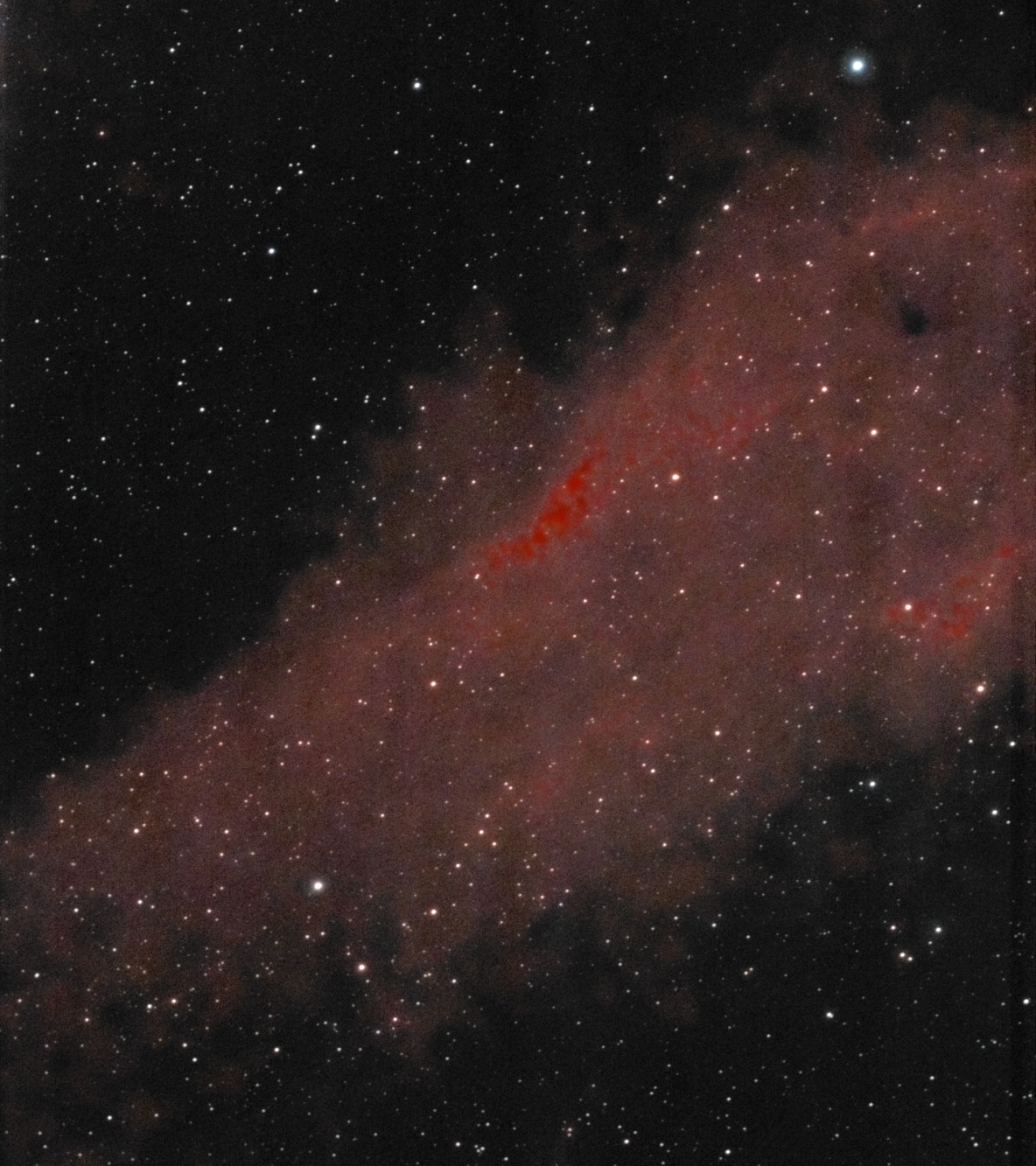
The California Nebula is a cloud of hydrogen about 1,000 light-years away in Perseus, about 100 light-years long. On the sky it stretches about two and a half degrees, five full moons, which is why it doesn’t fit in one frame.
It glows because of one star: Xi Persei, a very hot, blue star near the nebula’s southern edge, whose ultraviolet light strips electrons from the hydrogen. When they recombine, the gas gives off the deep red light of hydrogen-alpha.
Big as it is, it is faint. E. E. Barnard found it by eye in 1884, through a six-inch telescope, and it is hard to see even in a large one.
The lesson
A third of this night was lost to cloud, which rolled in just as the telescope turned to this target. It kept shooting through the gaps.
Two and a quarter hours of a big, bright nebula is a usable start, and every later night stacks on top of it. Waiting for a perfect night would have produced nothing.
Start with the conditions you have when the work compounds. A partial result that the next attempt builds on beats a perfect one you never begin.
One photo. One lesson.
New entries land when the sky cooperates. Get them by email, plus the Sitreps jobs newsletter — no schedule, no spam. Unsubscribe from either one anytime.
Object data
- Catalog
- NGC 1499 · Sharpless 2-220
- Constellation
- Perseus
- Type
- Emission nebula
- Distance
- ~1,000 light-years
- Size on the sky
- ~2.5°, five full moons; this frame holds the middle
- Lit by
- Xi Persei, a hot blue star near its southern edge
- Status
- LIVING ENTRY — 2.3 hours from one night, deepening this week