NGC 7635 — The Bubble Nebula
One star, blowing a bubble seven light-years wide
 Darth Vader (ZWO Seestar S50)
What you're looking at
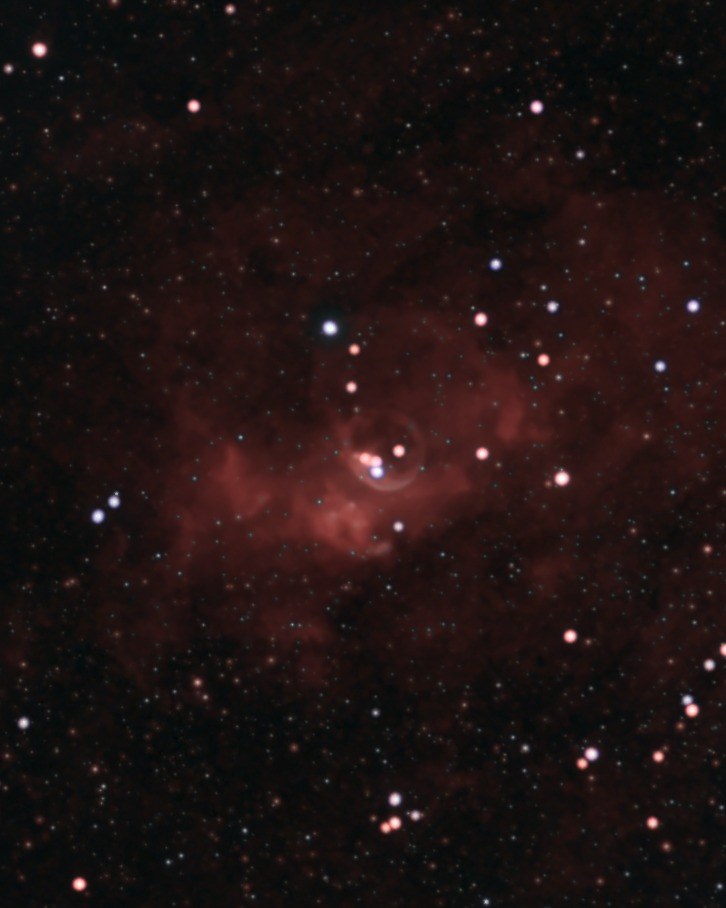
The Bubble is a shell of gas blown by a single massive young star, many times the Sun's mass, sitting near its center. The star's wind, streaming outward at more than a thousand kilometers per second, sweeps the surrounding gas into a thin, expanding shell about seven light-years across.
It sits in Cassiopeia, several thousand light-years away, at the edge of a larger molecular cloud. Where the bubble pushes into denser gas, the shell glows brighter, which is why one side often looks thicker than the other.
The star at the center will not live long by cosmic standards. Stars this massive burn through their fuel in a few million years and end as supernovae, so this bubble is an early chapter of the same story the Veil and the Jellyfish tell at the end.
The lesson
One star makes all of this. Its own output clears the space around it and shapes everything it touches.
That's usually how it works with people too: one person's steady output, pushed in every direction, defines the room the rest of the team gets to work in.
The shell is brightest where it meets resistance. Most of the visible work happens there.
One photo. One lesson.
New entries land when the sky cooperates. Get them by email, plus the Sitreps jobs newsletter — no schedule, no spam. Unsubscribe from either one anytime.
Object data
- Catalog
- NGC 7635 · Sharpless 2-162
- Constellation
- Cassiopeia
- Type
- Emission nebula (wind-blown bubble)
- Size
- About 7 light-years across
- Neighbor
- Open cluster M52, just outside this crop
- Status
- 5.2 hours dual-band over two nights, plus 17 minutes broadband for star color