Sitreps Astronomy
M81 and M82 — Bode’s Galaxy and the Cigar
Eight months after a five-minute smudge, the same pair in almost two hours
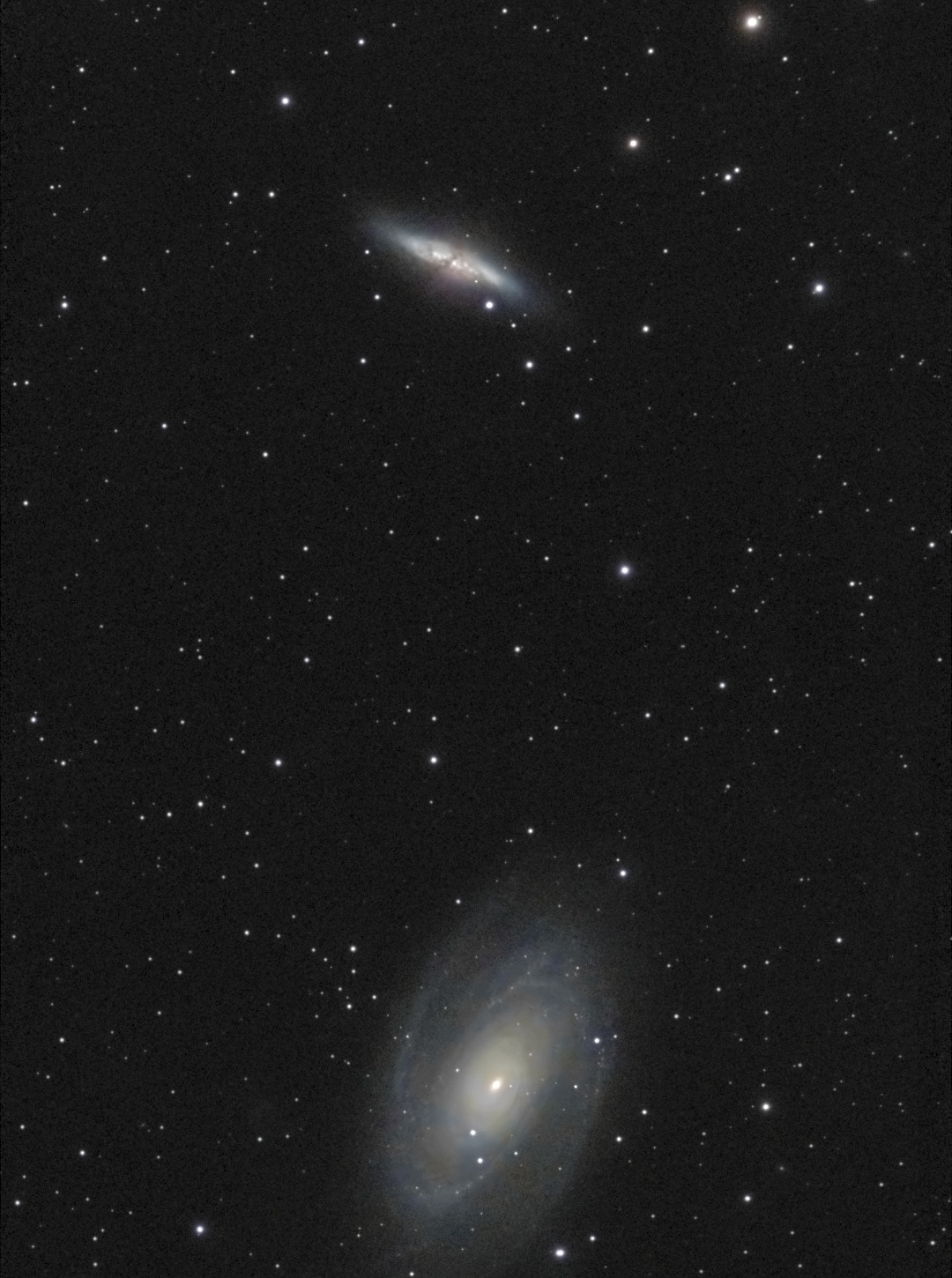
 Darth Vader (ZWO Seestar S50)
What you're looking at
M81 and M82 are about 12 million light-years away in Ursa Major, two of the brightest galaxies in a small group not far beyond our own Local Group. Johann Bode found both on the same night, December 31, 1774.
M81 is a grand-design spiral about the size of the Milky Way. M82, seen nearly edge-on, is a starburst galaxy: a close pass by M81 a few hundred million years ago stirred up its gas, and it is now forming stars many times faster than our galaxy does.
The dark, broken band across M82 is dust. Supernovae and winds from all those new stars are blowing hydrogen out of both sides of its disk, a red glow too faint to show in this broadband photograph.
The lesson
One of this telescope’s first deep-sky targets, in March 2026, was M81: five minutes of exposure, a grey smudge. It is on the first-month contact sheet in this journal.
Eight months later the same telescope pointed at it again and gave it almost two hours. The hardware hadn’t changed. What changed was everything around it: aligning the mount on the pole, knowing which exposure length to use, letting a robot run it overnight.
Go back to the first thing you tried and couldn’t do. It is the clearest measure of what you’ve learned since.
One photo. One lesson.
New entries land when the sky cooperates. Get them by email, plus the Sitreps jobs newsletter — no schedule, no spam. Unsubscribe from either one anytime.
Object data
- Catalog
- M81 (NGC 3031) · M82 (NGC 3034)
- Constellation
- Ursa Major
- Type
- Spiral galaxy (M81) and starburst galaxy (M82)
- Distance
- ~12 million light-years
- Separation on the sky
- About 0.6°, a little more than a full moon
- Discovery
- 1774 · Johann Elert Bode
- Status
- LIVING ENTRY — 1.8 hours, one night; more broadband nights this winter