Sitreps Astronomy
M45 — The Pleiades
Seven sisters wrapped in a dust cloud that was never theirs
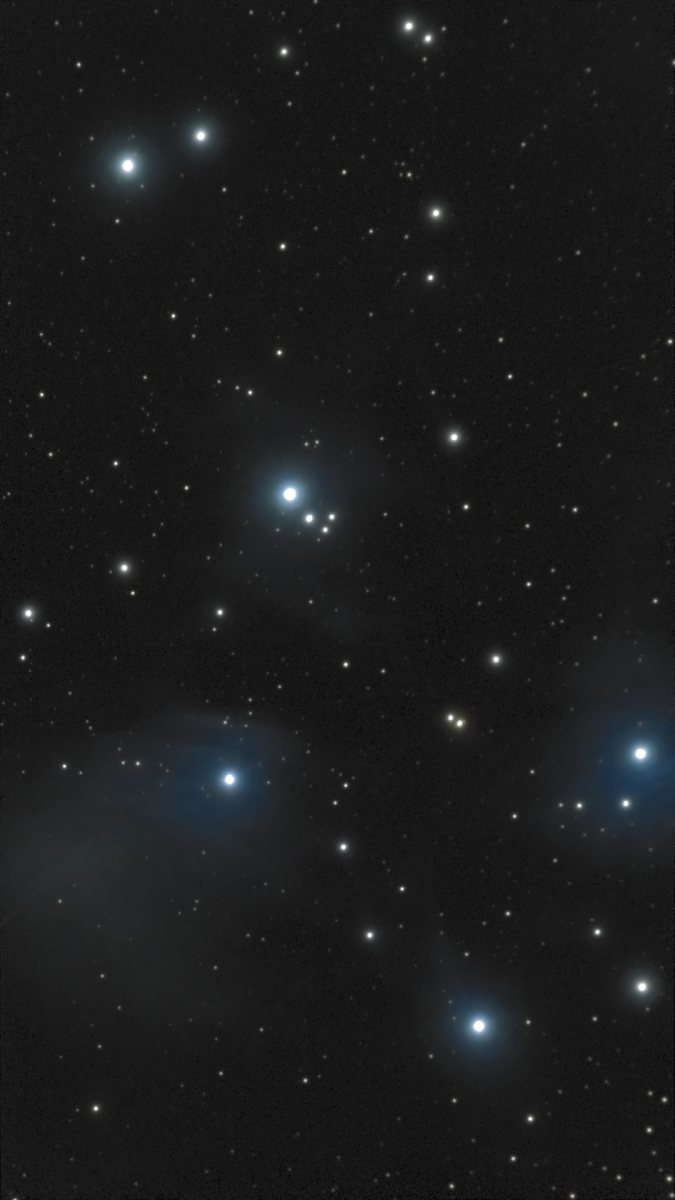
 Darth Vader (ZWO Seestar S50)
What you're looking at
The Pleiades are the most famous star cluster in the sky — visible to the naked eye, named by nearly every culture that ever looked up, from the Greek seven sisters to the Japanese Subaru to the Lakota and the Maori. About 1,000 stars, 444 light years away, all born together roughly 100 million years ago (recent, as stars go — they overlapped with the last dinosaurs).
The blue haze around the brightest stars is a reflection nebula: dust scattering the stars' light, and scattering blue most efficiently — the same physics that makes the daytime sky blue and the Iris Nebula glow.
Here's the twist astronomers only settled recently: that dust is NOT the cloud the Pleiades formed from. The cluster's birth cloud dispersed long ago. The stars are simply passing through an unrelated dust cloud right now, lighting it up in transit. In a few hundred thousand years they'll move on and the glow will go with them.
The lesson
The beautiful thing surrounding the Pleiades isn't theirs. They didn't form in it. They're just passing through it, and it glows because they happen to be here right now.
It's a strange, freeing idea: the atmosphere around a thing isn't always something it created or owns. Sometimes you move into a context, light it up by being there, and move on — and the glow was real even though it was never yours to keep.
Worth remembering about the teams, cities, and seasons you pass through. You lit them up. They lit you. Neither of you has to own it for it to have been real.
One photo. One lesson.
New entries land when the sky cooperates. Get them by email, plus the Sitreps jobs newsletter — no schedule, no spam. Unsubscribe from either one anytime.
Object data
- Catalog
- M45 · the Pleiades · the Seven Sisters
- Constellation
- Taurus
- Type
- Open cluster + reflection nebula
- Distance
- ~444 light-years
- Age
- ~100 million years
- Stars
- ~1,000
- The blue glow
- An unrelated dust cloud the cluster is passing through
- Known to
- Nearly every culture on Earth