M15 — Globular Cluster in Pegasus
A hundred thousand ancient stars with a collapsed core
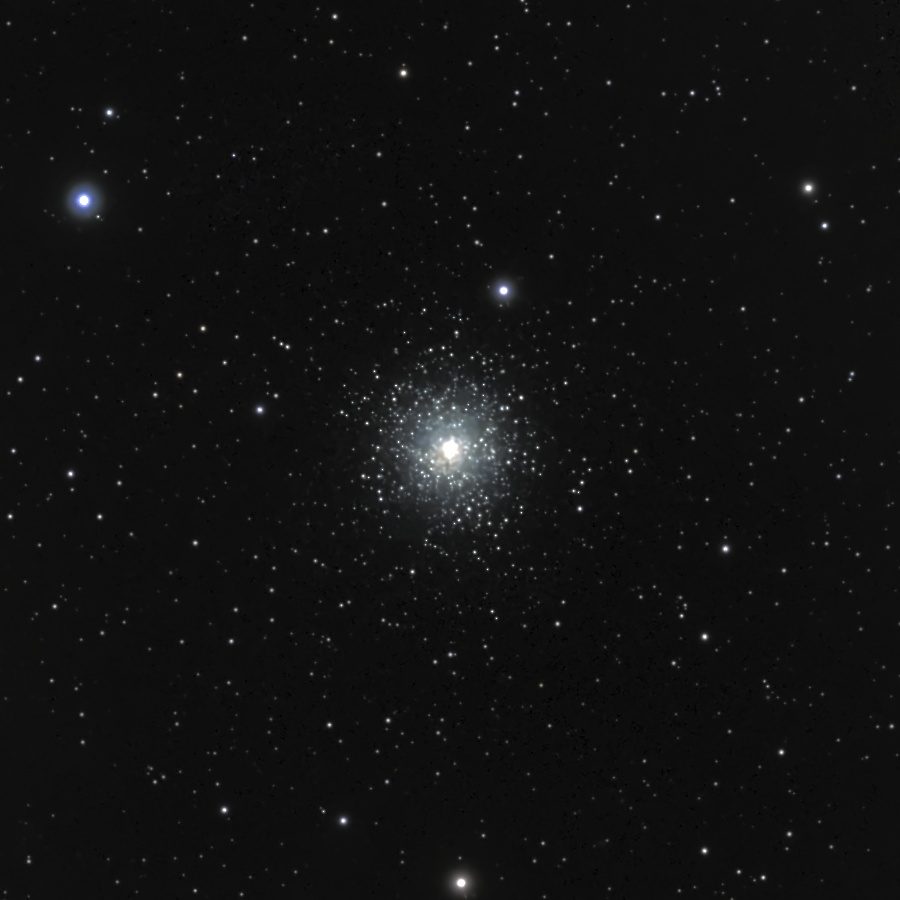
 Darth Vader (ZWO Seestar S50)
What you're looking at
M15 is one of the oldest globular clusters in the Milky Way — around 12 billion years, with a hundred thousand stars packed into a ball 175 light years wide. It orbits the galaxy far outside the disk, a relic from before the galaxy finished forming.
It's also one of the few clusters to have undergone core collapse: gravitational encounters over billions of years have funneled its heaviest stars into an extraordinarily dense center — possibly around an intermediate-mass black hole. Half the cluster's core light comes from a region only a tenth of a light-year across.
M15 also hosts Pease 1, the first planetary nebula ever discovered inside a globular cluster — a dying star's shed atmosphere glowing faintly amid a hundred thousand neighbors.
The lesson
Processing this image required treating the center and the edge as different problems.
Stretch for the faint halo stars and the core blows out into a featureless white disk. Protect the core and the halo disappears into the noise. The only honest image applies different curves to different regions — gentle where it's already bright, aggressive where it's starved.
Uniform policy across a non-uniform system destroys one end or the other. Segment first, then tune.
One photo. One lesson.
New entries land when the sky cooperates. Get them by email, plus the Sitreps jobs newsletter — no schedule, no spam. Unsubscribe from either one anytime.
Object data
- Catalog
- M15 · NGC 7078
- Constellation
- Pegasus
- Type
- Globular cluster (core-collapsed)
- Distance
- ~33,600 light-years
- Diameter
- ~175 light-years
- Age
- ~12 billion years
- Notable resident
- Pease 1 — first planetary nebula found in a globular
- Discovery
- 1746 · Jean-Dominique Maraldi