NGC 281 — The Pacman Nebula
A star factory with its own demolition crew, 9,500 light years away
 Eva (ZWO Seestar S50 Pro)
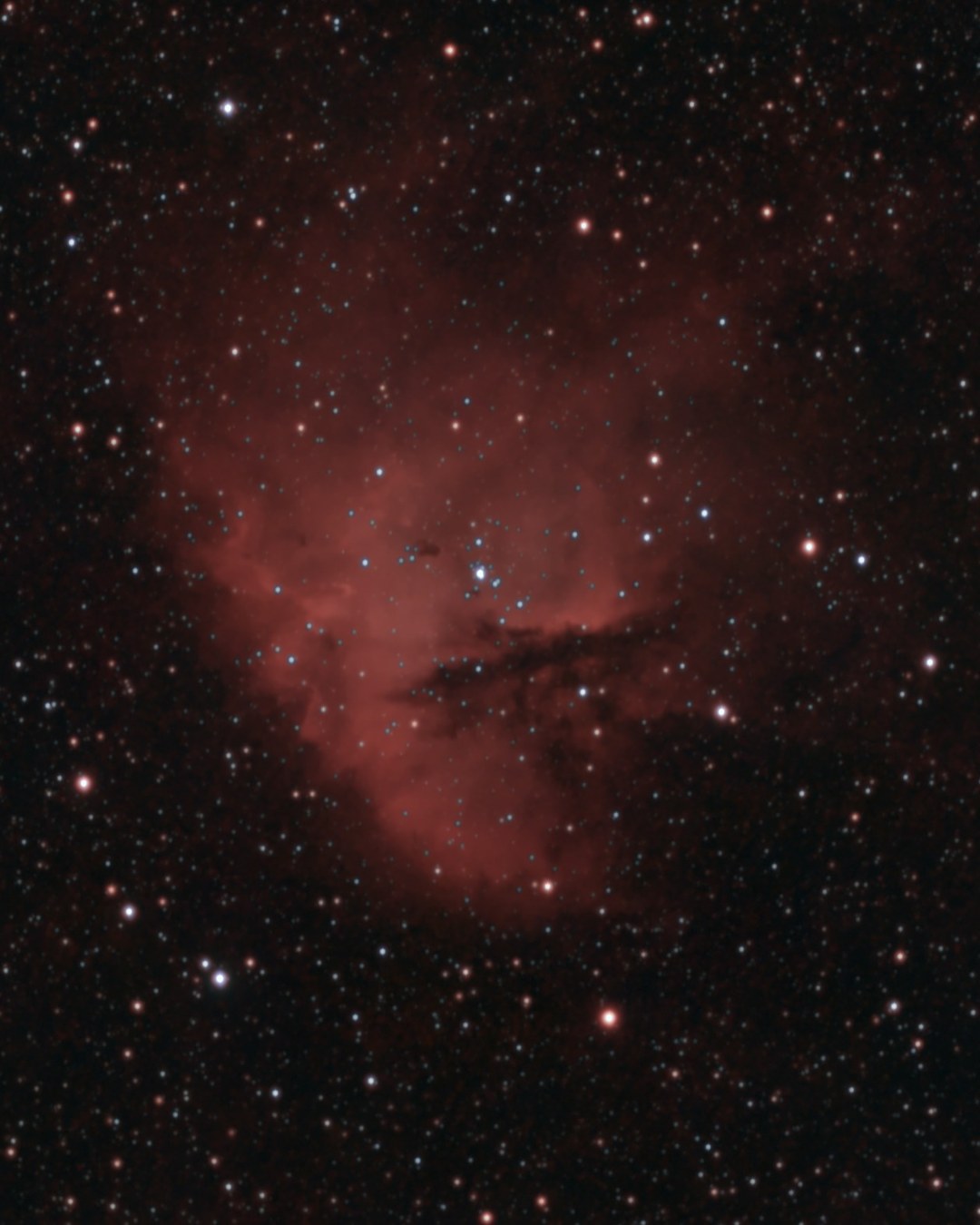
What you're looking at
NGC 281 earns its nickname from a wedge of dark dust that cuts into the glowing gas like an open mouth. That mouth isn't empty — it's a dense lane of cold dust in front of the nebula, blocking the red light behind it.
At the center sits a young star cluster, IC 1590, only a few million years old. Its hottest stars ionize the surrounding hydrogen to make it glow — and their radiation is also sculpting the dark pillars and globules scattered across the face, the same erosion-and-creation seen in the Eagle Nebula's famous pillars, here in miniature.
The whole complex is about 9,500 light years away and sits well above the plane of the Milky Way, which is why it stands so cleanly against the background instead of drowning in foreground stars.
The lesson
The most recognizable feature of this nebula is the part where there's nothing.
The 'mouth' that gives the Pacman its name isn't gas or stars — it's a dark lane of dust blocking the light, an absence shaped sharply enough to define the whole object. The negative space is the brand.
What's missing from a picture is structure too. The gaps in a plan, the silence in a conversation, the role nobody filled — read the absences; they're often doing more shaping than the things that are there.
One photo. One lesson.
New entries land when the sky cooperates. Get them by email, plus the Sitreps jobs newsletter — no schedule, no spam. Unsubscribe from either one anytime.
Object data
- Catalog
- NGC 281 · Sharpless 2-184
- Constellation
- Cassiopeia
- Type
- Emission nebula + young cluster
- Distance
- ~9,500 light-years
- Central cluster
- IC 1590 (a few million years old)
- The "mouth"
- A foreground dust lane, not a gap
- Integration
- 3.3 hours dual-band over two sessions, plus 32 minutes broadband for star color