Sitreps Astronomy
M33 — The Triangulum Galaxy
The third member of our Local Group, built from three nights and two telescopes
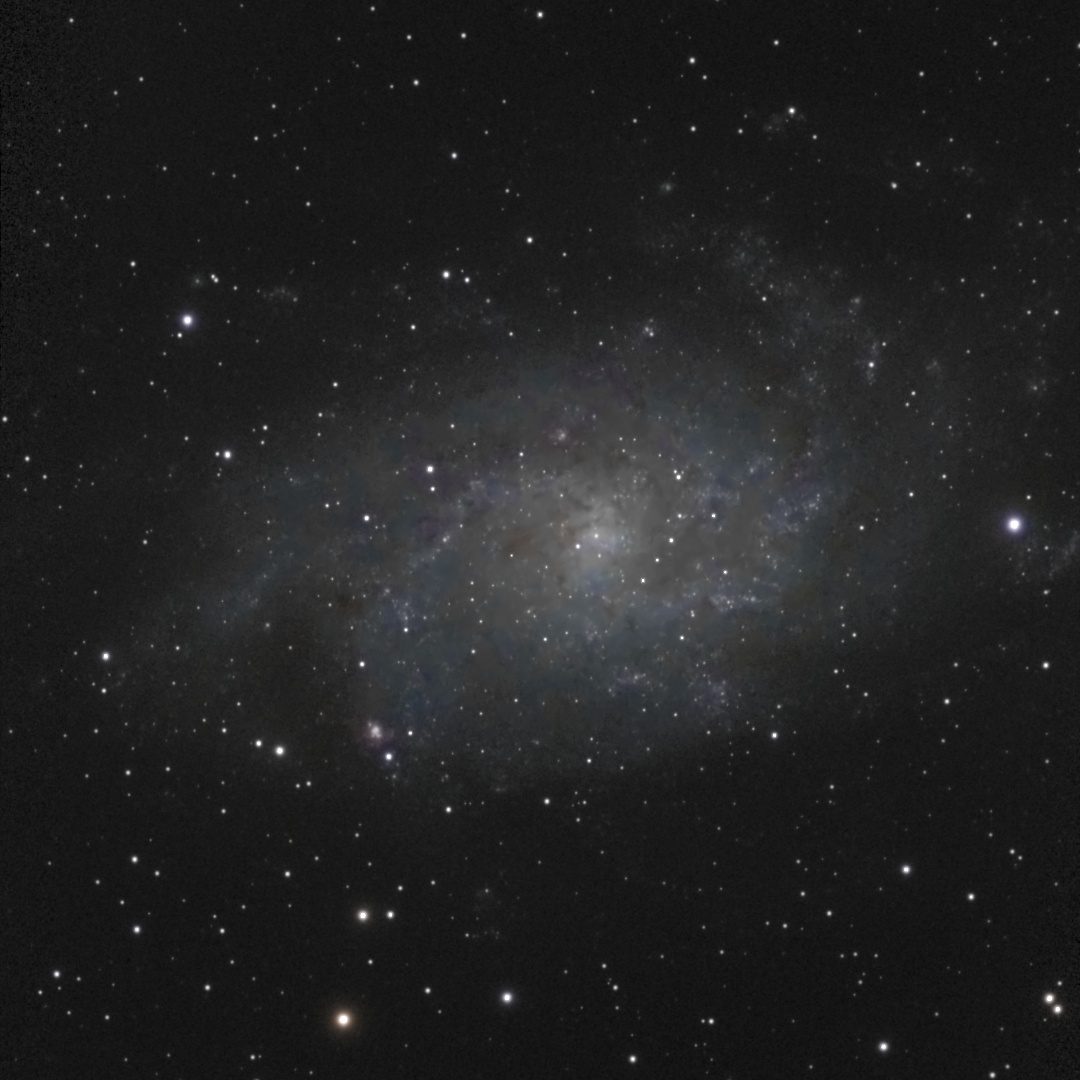

 Eva (ZWO Seestar S50 Pro) + Darth Vader (Seestar S50)
What you're looking at
M33 is the third-largest galaxy in our Local Group, after Andromeda and the Milky Way — a loose, face-on spiral 2.7 million light years away with about 40 billion stars. It's gravitationally bound to Andromeda and may be its satellite, the two of them bearing down on the Milky Way together.
It's notorious among astrophotographers for its low surface brightness: its light is spread so thin across the sky that it's actually harder to photograph well than galaxies ten times farther away. Under a truly dark sky it's the most distant object visible to the naked eye; under a suburban sky it nearly vanishes.
The pink knots along the arms are giant star-forming regions. The brightest, NGC 604, is one of the largest stellar nurseries known anywhere — 1,500 light years across, forty times the size of the Orion Nebula.
The lesson
One hour on this galaxy produced a smudge. Two nights, registered and stacked, produced a portrait. A third night, on a different telescope, deepened it.
Nothing about night two was special — same sky, same gear, same suburb. The only thing that changed is that the light from both nights was made to land on the same pixels, so it accumulated instead of starting over.
Faint things don't reveal themselves to intensity. They reveal themselves to alignment — effort that lands in the same place, night after night, until the signal outgrows the noise.
One photo. One lesson.
New entries land when the sky cooperates. Get them by email, plus the Sitreps jobs newsletter — no schedule, no spam. Unsubscribe from either one anytime.
Object data
- Catalog
- M33 · NGC 598
- Constellation
- Triangulum
- Type
- Face-on spiral galaxy (SA(s)cd)
- Distance
- ~2.73 million light-years
- Diameter
- ~60,000 light-years
- Star count
- ~40 billion
- Notable feature
- NGC 604 — one of the largest star-forming regions known
- Naked-eye limit
- Most distant object visible without a telescope, under dark skies